

Electric Scooter Display Guide: 5 Things Brands and Manufacturers Should Check
08.26.2026
If you search for 'electric scooter display' today, most of the results will be about buying replacement parts or fixing broken screens. This is useful if you own one scooter. However, it's not so useful if you're manufacturing thousands of them.
For scooter brands and manufacturers, the display is much more than just a spare part. It's the main way riders interact with the machine. Riders constantly check it for information such as speed, battery level and error codes. Get the display wrong, and you'll get returns, complaints and warranty claims. Get it right, however, and it becomes a quiet reliability advantage.
This guide explains what matters when choosing a display for electric scooter production, covering the technology options, durability specifications, and sourcing process.
What Is an Electric Scooter Display, and Why It Matters More Than You Think
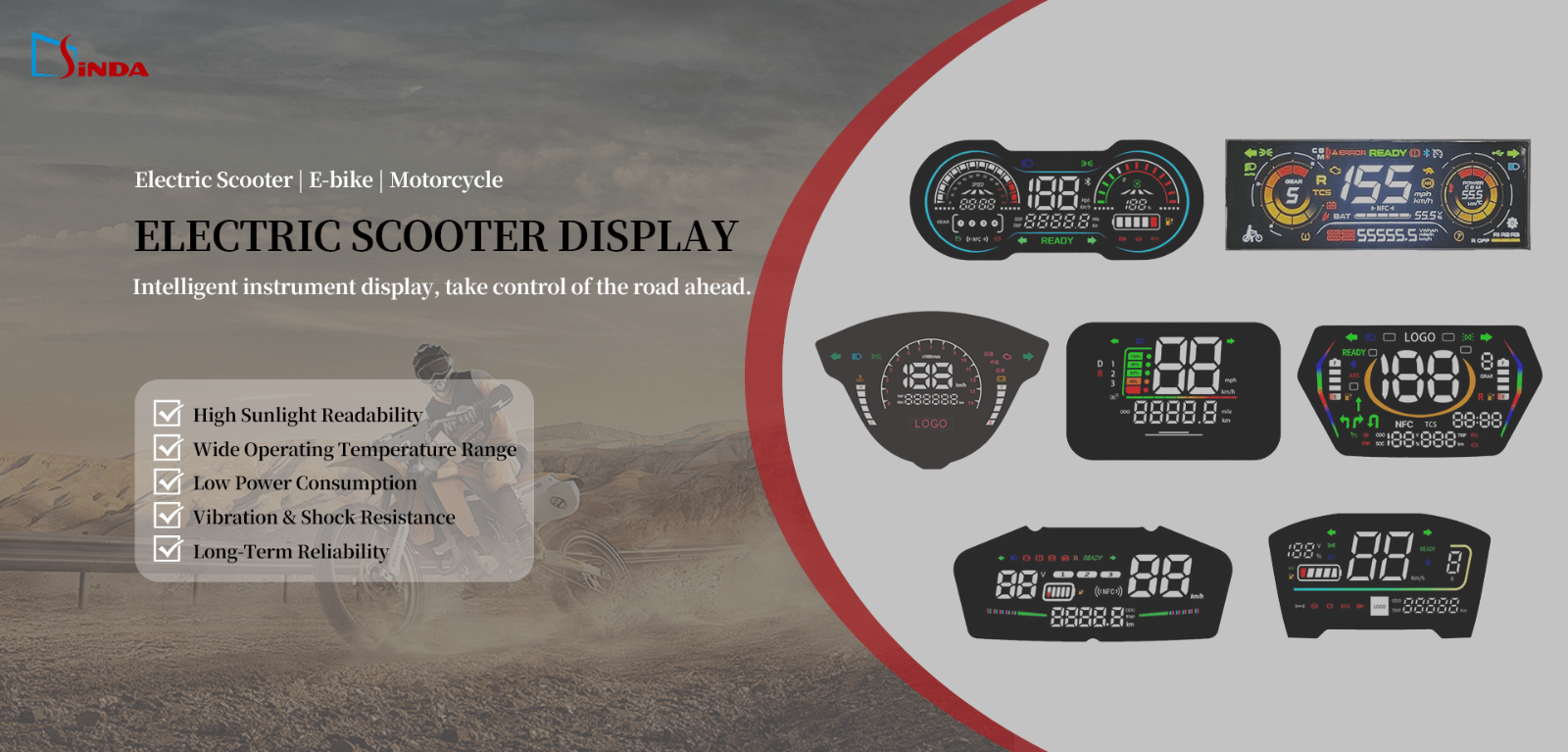
An electric scooter display is the screen module on a scooter's handlebar that shows the scooter's speed, battery level, distance travelled, current mode and any error codes in real time.
It sounds simple. But it isn't. This small module has to survive vibration, rain, temperature fluctuations and direct sunlight every single day for years. It also has to keep working after being pressed thousands of times, dropped dozens of times, and constantly exposed to dust and road grime.Yet most online content only covers what to do after failure. Few sources talk about how to choose the right display before production starts.
That's the gap this guide fills. A well-chosen display module reduces field failures, cuts after-sales costs, and keeps riders confident in the product. A poorly-chosen one does the opposite — quietly, ride after ride, until the complaints add up. By the time a pattern of returns shows up in your after-sales data, the display spec is usually already locked into thousands of units on the road.
The good news: none of this requires guesswork. Display technology, durability ratings, and sourcing timelines are all knowable in advance. This guide breaks each one down.
COB, COG, or TFT: Which Display Technology Fits Your Scooter?
Not all scooters require the same display. The right choice depends on factors such as your product tier, budget and the amount of information you need to display.
Technology | Best For | Power Use | Cost Level | Typical Info Shown |
COB Character LCD | Entry-level commuter scooters | Very low | Low | Speed, battery, basic icons |
COG LCD | Mid-range models needing sharper icons | Low | Low–moderate | Speed, mode, battery segments |
TFT Display | Premium or smart scooters | Moderate | Moderate–high | Full color, graphics, connectivity status |
COB / COG Character LCD: The Low-Cost, Low-Power Choice
COB (Chip on Board) and COG (Chip on Glass) displays are monochrome LCD modules that show fixed segments or basic icons. They are built for simple, reliable readouts.
They are ideal for entry-level and mid-range scooters. Power draw stays low, which matters for battery life. Cost stays low too, which matters at scale. If your scooter just needs to show speed, battery, and a few status icons clearly, this is often the smarter choice — not the cheaper compromise.
TFT Display: Full Color, More Information, More Impact
A TFT (thin film transistor) display is a colour LCD module capable of showing graphics, animations and detailed data layouts.
TFT screens are found on premium or 'smart' scooters — models with app connectivity, ride modes, or navigation prompts. They cost more and draw more power, so they make sense when the extra visual information genuinely improves the product, not just the spec sheet.
Outdoor Durability: What Specs Actually Matter
This is the part most consumer guides skip entirely — and it's exactly where scooter brands lose the most money if they get it wrong.
Q: Does a higher IP rating mean the display is fully waterproof?
A: No. IP ratings measure resistance, not immunity. The first digit rates dust protection; the second rates water protection. IPX5 handles rain and splashes. Full submersion needs IPX7 or higher — and most scooter displays don't need that level.
Q: Is a display "outdoor-ready" just because it's bright?
A: Not on its own. Brightness solves sunlight readability. IP rating solves moisture. Temperature range solves heat and cold. A display needs all three specs matched to your riding conditions — not just one.
How Much Sunlight Does a Display Really Face?
Sunlight intensity varies a lot by region, and that variation should drive the spec — not a generic "outdoor-rated" label.
Market | Daily Peak Sun Hours | Sunlight Profile |
Phoenix, Las Vegas (US Southwest) | 6.5–7.5 | Desert-strength light, midday irradiance above 900 W/m² |
Los Angeles, San Diego (US West Coast) | 5.5–6.5 | Strong summer sun, Mediterranean climate |
Dallas, Atlanta (US South) | 5.1–5.4 | Consistently bright |
Chicago, New York (US Northeast/Midwest) | 4.5–4.6 | Moderate, seasonal swings |
Seville, Madrid, Athens (Southern Europe) | 4.5–5.5 | Close to US southern-market intensity in summer |
Munich, Milan (Central Europe) | 3.0–3.5 | Moderate, strong seasonal drop-off |
London, Amsterdam, Hamburg (Northern Europe) | 2.5–2.8 | Overcast much of the year |
The takeaway: U.S. markets, especially the Southwest and South, see meaningfully stronger sunlight than most of Europe. Southern European cities are the exception — their summer intensity approaches U.S. southern-market levels.
How Often Do Riders Actually Ride in the Rain?
Q: Is waterproofing a "nice to have" for scooter displays?
A: No. Field data says otherwise. Research on shared e-scooter usage found roughly 30% of rides happen in wet conditions, and rainfall drops hourly ridership by only about 23–26% — riders keep going in the rain far more than assumptions suggest. Cities like London, Amsterdam, Seattle, and Vancouver see rain on close to 30% of commuting days each year. For a display, that means waterproofing isn't an edge case — it's a routine operating condition.
Brightness: Matching Nits to the Market
· Below 500 nits: unreadable in direct sunlight, a real safety risk — riders can't confirm speed or battery level.
· 1,000 nits: the general industry threshold for reliable outdoor readability.
· 1,500 nits: a safe baseline for most US markets and for Southern European summer conditions.
· 2,000+ nits: recommended for scooters sold specifically in high-glare markets such as Phoenix, Las Vegas or Southern Europe.
Recommendation: aim for 1,500 nits for a single global specification, or a minimum of 1,000 nits if the product is only being shipped to Northern Europe.
Pairing the panel with an anti-reflective coating or polariser improves readability further without increasing brightness — and battery drain — any more than necessary.
IP Rating: Matching the Real-World Wet-Riding Rate
· First digit (0–6): protection against dust and solid particles
· Second digit (0–9): protection against water ingress
· IP54: entry-level, splash resistance only — not recommended given how often riders ride wet
· IP65: dust-tight with protection against low-pressure water jets — the industry-recommended baseline for commuter scooters
· IP67: protection against temporary immersion — worth the upgrade for shared fleets or rainy-climate markets like London, Amsterdam, or Seattle
The European PLEV safety standard (EN 17128) stipulates that electrical components must have a minimum IPX4 rating, but most display suppliers now manufacture products with an IP54 rating or higher as standard. One caution for buyers: always confirm the full two-digit rating. A spec sheet listing only "IPX5" hasn't been dust-tested at all — a common shortcut in marketing materials that's worth catching before it becomes a field problem.
Operating Temperature: Often Overlooked, Rarely Optional
· Standard range (0°C to 40°C): workable for mild, temperate-climate use only
· Extended range (-20°C to 65°C): the recommended baseline for U.S. and European markets, covering both winter commutes and midday desert heat
A display that appears to perform well in laboratory testing may slow down, dim or freeze in real winter conditions if the temperature range is not specified in advance. This is easy to miss during sourcing because it rarely shows up until the first cold season after launch — by which point it's a warranty issue, not a spec revision.
Quick Reference: Recommended Spec by Market
Spec | US Market | Europe | Global (single spec) |
Brightness | ≥1,500 nits | ≥1,000 nits | ≥1,500 nits |
IP Rating | ≥IP65 | ≥IP65 (IP67 for rainy cities) | ≥IP65 |
Operating Temp | -20°C to 65°C | -20°C to 65°C | -20°C to 65°C |
Panel Type | Transflective TFT + AR coating | Same | Same |
Sinda Display's outdoor-application experience with fuel dispensers, EV chargers, and meter displays — all exposed to the same rain, heat, cold, and direct sun as scooters — directly informs how we spec displays for scooter manufacturers. These are demanding, non-consumer environments where a display simply isn't allowed to fail quietly in the field.
From Prototype to Production: How Custom Display Sourcing Works
Sourcing a display involves more than just picking a part number from a catalogue. For most scooter manufacturers, there is a clear process to follow:
· Requirement discussion: display size, resolution, interface, and target environment
· Prototype sampling: initial units built to your specification for testing
· Testing and adjustment: brightness, IP rating, and durability verified against real conditions
· Production ramp-up: stable, consistent output at scale with quality checks in place
Two questions come up in almost every conversation: minimum order quantity, and how long sampling takes. Both vary by display type and complexity — which is exactly why an early conversation with your supplier matters more than searching for a generic answer.
Timelines also depend heavily on how early you bring your supplier into the design process. Sharing your handlebar layout, target market, and expected riding conditions before finalizing mechanical design gives more room to match the right display technology, IP rating, and shape — instead of retrofitting a display around a design that's already locked.
Case Study: Custom VA LCD for an India-Market Electric Two-Wheeler
To make this concrete, here's how a recent custom project actually played out.
A two-wheeler brand targeting the Indian market needed a dashboard display built for local riding conditions — high heat, strong outdoor sunlight, and a wide range of road environments. Sinda Display developed a custom VA LCD to meet those requirements:
· Panel type: VA LCD with 6 o'clock viewing angle, chosen for clear visibility under strong outdoor sunlight
· Driver IC: ST7037, 1/4 duty, 1/3 bias — for stable, low-power operation
· Backlight: white LED, chosen for even brightness and long working life
· Operating temperature: -20°C to +70°C, matched to India's temperature extremes
· Customization: vehicle-specific speed icons, battery indicators, turn signals, and fault-warning graphics
Development timeline: 16 working days, start to production-ready.
Phase | Days | What Happened |
Requirement & design lock-in | 1–4 | Specs confirmed, circuit and structure finalized, project kicked off |
Tooling & first sample | 5–8 | Custom mold and backlight development, first working prototype lit up |
Vehicle integration & testing | 9–12 | High/low-temperature, aging, and vibration testing; icon and function tuning; design finalized |
Trial run & handoff | 13–16 | Production line tuning, process lock-in, small-batch trial run, full inspection standard in place |
MOQ, structured by stage:
· Sampling: 50 units
· Small-batch trial: 1,000 units
· Standard production run: 5,000 units per batch
· Long-term annual orders: as low as 3,000 units per batch
Yield and field results:
· Trial-run yield: 96.2%, with minor issues resolved through process refinement
· Stable production yield: 98.5%–99.2%
· Field failure rate after delivery: under 0.03%, with no batch-level quality complaints reported to date
The result: a display matched to India's climate and riding conditions, now in stable monthly production, helping the client move faster into the Indian two-wheeler market without absorbing the cost of field failures along the way.
Details on the customization workflow are outlined on our Custom Solution page.
Frequently Asked Questions
Q: My scooter's display keeps failing in the field. Is that a design problem or a quality problem?
A: Often both are involved, but they're different fixes. Repeated failures across many units usually point to a design mismatch — wrong IP rating or brightness for the environment. Inconsistent failures on some units, not others, usually point to manufacturing quality control. A good supplier will help you identify the issue before recommending a solution.
Q: Should we use an off-the-shelf display or go custom?
A: Off-the-shelf displays are ideal for quick, low-volume launches where standard specifications are sufficient. Custom makes sense once you need a specific outdoor rating, a particular shape to match your handlebar design, or you're placing large enough orders that per-unit cost savings add up.
Q: How much does outdoor durability add to the cost?
A: It varies by how far you're pushing the specs, but a moderate IP rating (IPX5) and adequate brightness (600–800 nits) typically add a modest premium over base models — usually far less than the cost of field failures and warranty claims down the line.
Q: Can one display work across multiple scooter models?
A: Sometimes, if the interface and mounting are standardized. But matching the display specifically to each model's target market and price point usually gives better cost efficiency and reliability over time.
Choosing the Right Partner
A scooter display looks small on a spec sheet, but it carries a lot of responsibility — reliability, rider trust, and after-sales cost, all riding on one small module.
Sinda Display works with manufacturers across fuel dispensers, EV chargers, industrial control, and other outdoor, non-consumer applications — environments that demand the same durability standards as electric scooters. That focus, paired with stable production and realistic pricing, is what we bring to every custom display project.
Do you have a project in mind? Get in touch to discuss your requirements, or browse our full product range to find the right fit for you.