

2025 China TFT Display Industry Review and 2026 Outlook
12.26.2025
In 2025, amid a global landscape of diverse display technologies, China's TFT (Thin Film Transistor) display industry solidified its position as a core global supplier and is transitioning from "scale leadership" to a new strategic phase of "quality leadership." TFT technology serves not only as the foundation for traditional TFT-LCD but also as the invisible engine driving cutting-edge technologies like OLED and Micro LED. The table below outlines the core trends of China's TFT display industry in 2025:
| Dimensions | Core Progress and Current Status in 2025 | Data/Performance |
| Industry Scale and Position | Global dominance in TFT-LCD solidified, with the entire industrial chain of new display technologies emerging | TFT-LCD holds a global market share of 75%-80%; the total scale of the new display industry exceeds RMB 740 billion (2024 baseline), with a global market share surpassing 49%. |
| Technology Innovation Direction | Foundational technologies continuously iterated, empowering cutting-edge displays through deep AI integration | High-performance backplane technologies like Oxide TFT and LTPS TFT gain widespread adoption; TFT emerges as the core driving backplane for Micro LED; AI permeates the entire R&D, manufacturing, and application chain. |
| Application Ecosystem Evolution | Transitioning from "single hardware" to "scenario integration," advancing simultaneously in B2B and B2C markets | Deep integration with B2B applications including automotive, medical, and industrial control; consumer demand driven by ultra-high definition, interactivity, and form factor innovation; industry positioning shifting from "displays" to "scenario-adaptive interfaces." |
| Industrial Chain Synergy | Shifting from "single-point breakthroughs" to "team-based operations," accelerating ecosystem aggregation | Significant increase in domestic production rates for key materials and equipment; establishment of a collaborative innovation system centered on leading enterprises and anchored by industry alliances. |
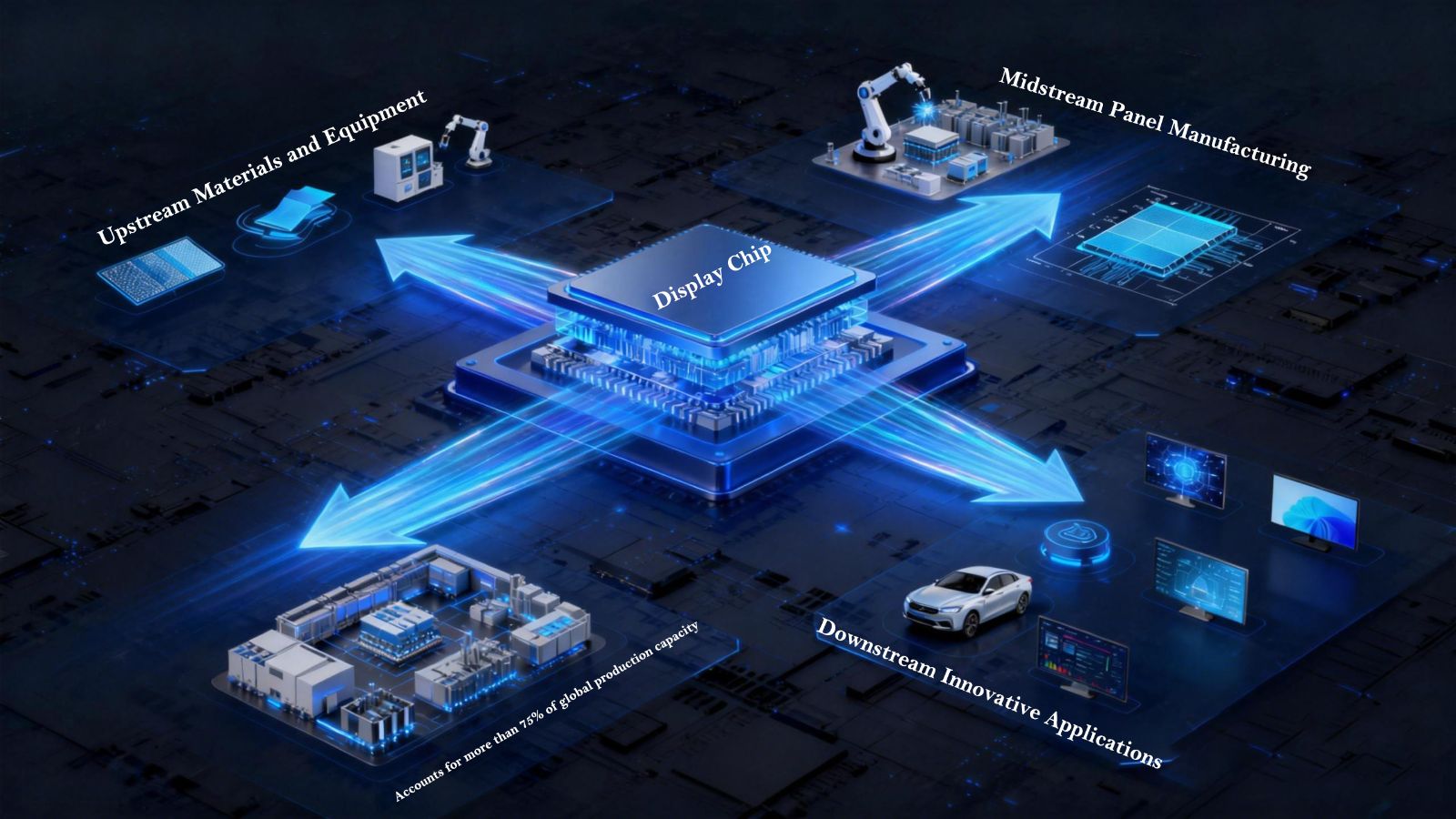
I. 2025 Retrospective: Deepening Industrial Foundations and Technological Paradigm Shifts
By 2025, China's TFT display industry had evolved significantly. It had expanded in terms of size, but also in other ways. It had changed a lot in terms of technology, industry and how it is used.
1. Industrial Cornerstone: TFT-LCD Dominance and Breakthroughs Across the Entire Supply Chain
China's TFT-LCD industry has further solidified its global leadership, with market share climbing from under 50% five years ago to 75%-80%, cementing its position as the undisputed pillar of the sector. More significantly, the entire new display industry built upon TFT technology has achieved comprehensive breakthroughs: By 2024, the industry scale exceeded 740 billion yuan, with a global market share surpassing 49%. Within this, China holds the top global position in both panel and key material markets, commanding 55% and 43% market shares respectively. This signifies that China's display industry has established a complete and competitive industrial chain spanning materials, equipment, panels, and end applications.
2. Technological Evolution: TFT as the "Enabling Foundation" for Next-Generation Displays
A key consensus in 2025 is that TFT is not a technology destined for replacement, but rather a continuously evolving foundational platform. Its evolution manifests in two dimensions:
Always getting better at what you do: The latest backplane technologies, such as oxide TFT and LTPS (Low-Temperature Polycrystalline Silicon) TFT, make it possible to move electrons more quickly. This means that LCDs can have a higher resolution, faster refresh rates and lower power consumption, which is what high-end liquid crystal displays need.
Enabling Cutting-Edge Breakthroughs: TFT technology directly catalyses the most disruptive innovations. For instance, the TFT-based Micro-LED technology roadmap achieves milestone progress in 2025. Chengdu Chenxian Optoelectronics established mainland China's first TFT-based Micro-LED production line and unveiled the world's first 270-inch 8K TFT-based Micro-LED display. The TFT backplane provides precise, stable electrical drive for Micro-LED's massive pixel array, serving as the core prerequisite for its large-scale industrial application. Similarly, in the OLED field, high-performance TFT backplanes are essential for achieving high-resolution, high-brightness AMOLED screens.
3. Ecological Reconstruction: From Industrial Chains to "Innovation Communities"
The industrial development model has undergone a fundamental shift, evolving from isolated corporate competition to collaborative innovation across the entire industrial chain—a "team effort." This transformation is most evident in:
Supply Chain Autonomy and Control: At the display equipment and materials event, domestically produced 8.6-generation large-panel lamination equipment, high-reliability automotive bonding materials, and lithography machines covering all generations made their debut. Their performance now rivals international standards, significantly reducing construction and operational costs for panel manufacturers.
Alliance-Driven Collaborative Breakthroughs: For technically challenging, long-chain sectors like Micro-LED, China's Micro-LED Strategic Alliance added over 20 new members in 2025. This initiative integrates upstream and downstream resources to tackle critical challenges such as mass transfer and defect detection/repair. This "chain-leader-led, alliance-collaborative" model significantly boosts innovation efficiency.
4. Application Innovation: "AI + Display" Unleashes Scenario Revolution
The display industry is shifting from being a hardware manufacturer providing "a screen" to an ecosystem enabler delivering "intelligent interactive solutions." Artificial intelligence has become the core driving force.
Empowering the Industrial Sector (B2B): AI technology is deeply integrated into panel R&D, design, process optimization, and manufacturing (e.g., AI-powered appearance inspection equipment), boosting yield rates and efficiency.
Redefining the Consumer End (C-End): AI transforms display devices into smart terminals. Transparent screens with AI translation capabilities are deployed in airports and tourist attractions; AI glasses focus on lightweight applications like information prompts and navigation, prioritizing wearability. Simultaneously, technologies like ultra-high definition (8K) and glasses-free 3D displays open new frontiers for consumer experiences.
II. Outlook for 2026: Collaborative Advancement on the Path of High-Quality Development
In 2026, China's TFT display industry will carry on growing as part of the 15th Five-Year Plan, which is a scientific plan for the country. The 15th Five-Year Plan is based on three ideas: "consolidating strengths, expanding frontiers, and deepening integration."
1. Policy and Industrial Direction: Strengthening Top-Level Design, Focusing on Core Capabilities
The Ministry of Industry and Information Technology has clearly said that it will improve the top-level design and scientifically plan the development strategy for the new display industry during the 15th Five-Year Plan period. The main things the government is planning to do are expected to include:
Making industrial chains stronger: We will carry on supporting research and development, and making critical materials and important equipment more widely available. We will also make sure that there is a safe and reliable supply of these goods, and that industry is protected.
Getting everyone to work together to make new ideas: We want to make the most of the five most important things: technology, industry, market, money, and talent. We can do this by bringing these things together and having competitions to come up with new ideas. This will help the industrial ecosystem.
2. Technology Development Forecast: Parallel Advancement of Diverse Technologies, with TFT's Pillar Role Becoming More Prominent
In the future, display technologies will develop in a way where different approaches exist and compete with each other, rather than one technology replacing another.
TFT-LCD: It will continue to be popular in large markets (for example TVs and commercial displays) and in industrial and automotive applications where cost and longevity are important. This is because it is both very reliable and good value for money.
TFT-Enabled Frontier Technologies: TFT-based Micro-LED will remain a hotspot for R&D and investment, with breakthroughs focused on overcoming cost barriers. It will achieve scaled applications first in high-end commercial displays, televisions, and AR near-eye displays. Concurrently, silicon-based OLED (Micro OLED), as the ideal display solution for VR/AR devices, will see intensive research into its backplane drive technology.
3. Market and Application Trends: Immersion, Contextualization, and Sustainability
Lots of people are enjoying experiences where they can really immerse themselves. As ultra-high-definition content and 5G networks become more common, 8K displays will be used not just by professionals but also by people at home. Another important innovation will be naked-eye 3D displays, which are the next generation of human-machine interfaces.
Deep Integration Across Vertical Industries: Display technologies will integrate more closely with smart connected vehicles, smart healthcare, digital cultural tourism, and the metaverse. For instance, demand for high-brightness, high-reliability TFT displays will grow steadily in scenarios like multi-screen coordination in vehicles and outdoor information displays.
Green and Low-Carbon Consensus: Low-power display technologies like e-paper will see increased adoption in static information display scenarios such as retail and office settings. Concurrently, green manufacturing processes and circular economy models across the entire supply chain will gain heightened attention.
Conclusion
To sum up, 2025 is a very important year for China's TFT display industry. It will show the world that China is the best at making TFT displays. And it will change how the displays are made. TFT technology has shown that it is still alive and well, and has a lot of value. Looking ahead to 2026, China's TFT display industry will advance more steadily and confidently, driven by policy guidance, technological synergy, and innovation in application. It will make the most of all the advantages it has in the display industry, overcome any technological problems, and start a new era of intelligent "display-empowered everything" by working closely with other industries.